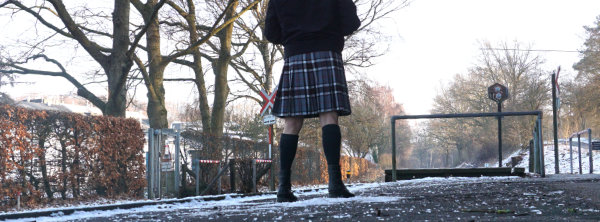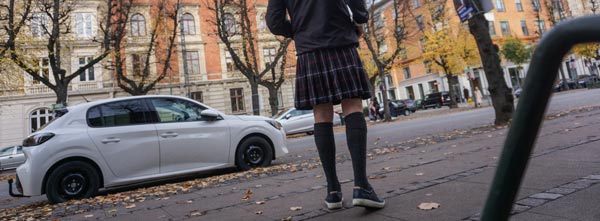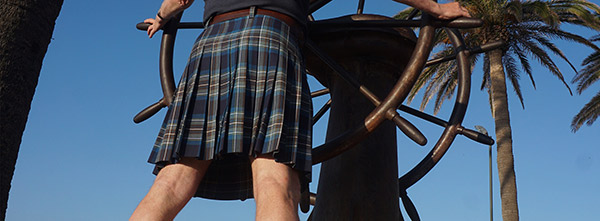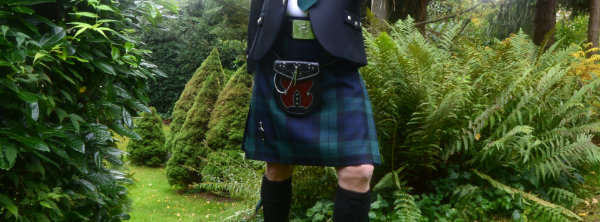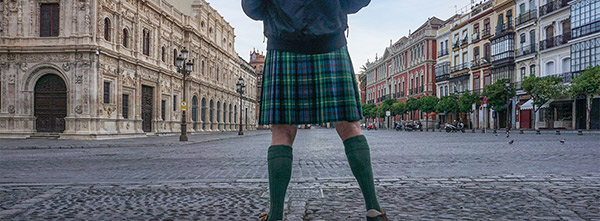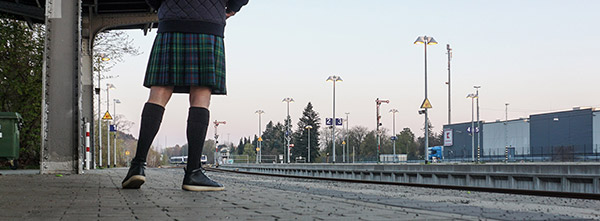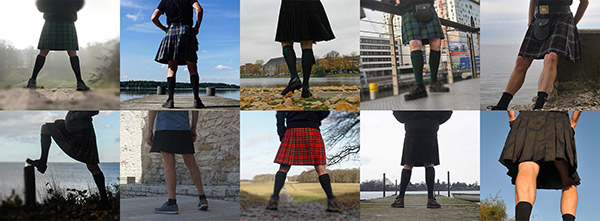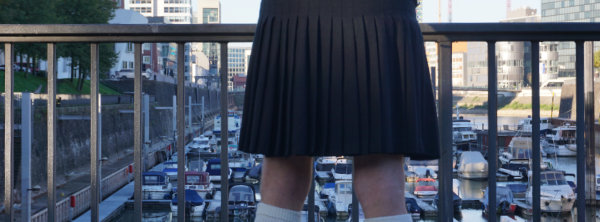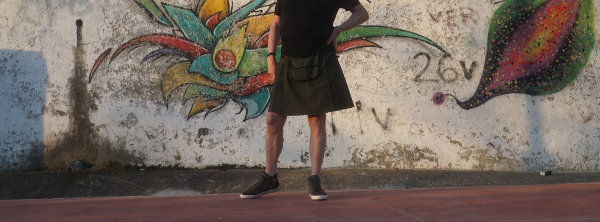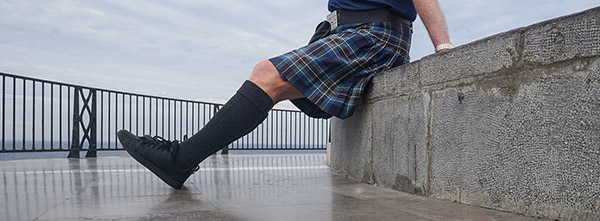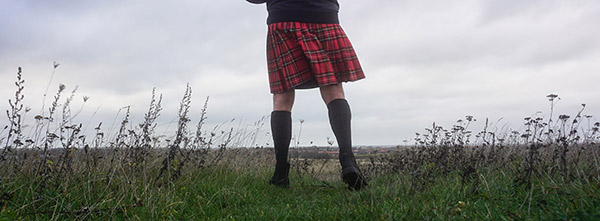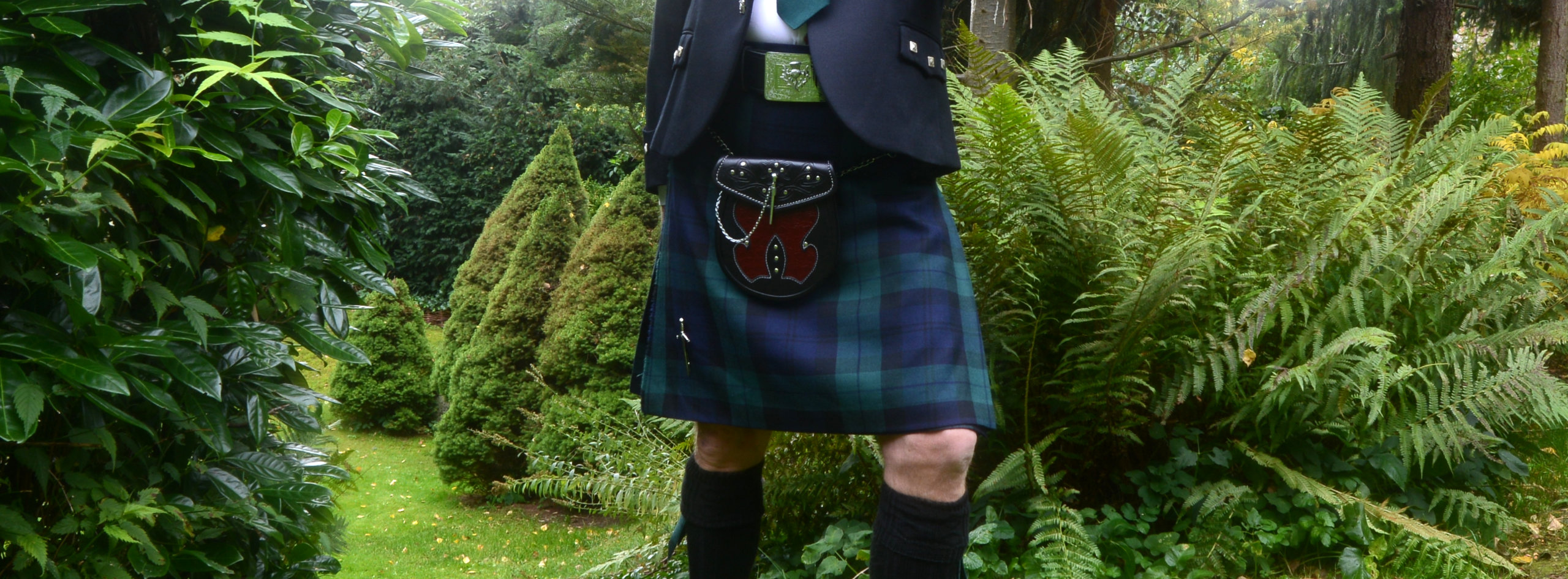
Ready for the opera house.
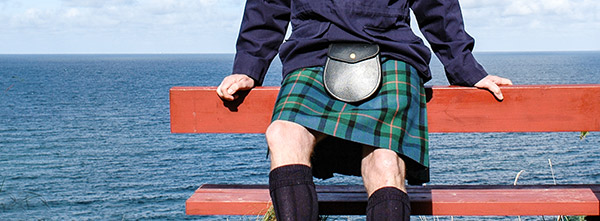
The sporran is of the semi-dress type.
5-yard kilt, 16. oz. wool, sewn in Scotland.
Black Watch tartan.
Kilt accessories
Don't get ripped off on things you don't need. The list of accessories is long, really long. And within every category there are so many varieties. But don't despair. Perhaps you don't need any at all?
By all means, you can do with very few, and they don't need to cost a fortune.
Find out, which accessories might be close to must-haves, which ones might be nice to have, and which ones you shouldn't consider at all for casual and smart casual wear, and some not even for dress-up events.
Kilt accessories are related to the traditional kilt.
Really casual
When going really casual you don't need any at all. Especially in summer when you would otherwise wear shorts. To consider might be a kilt belt. Otherwise, simply wear one of your normal belts.
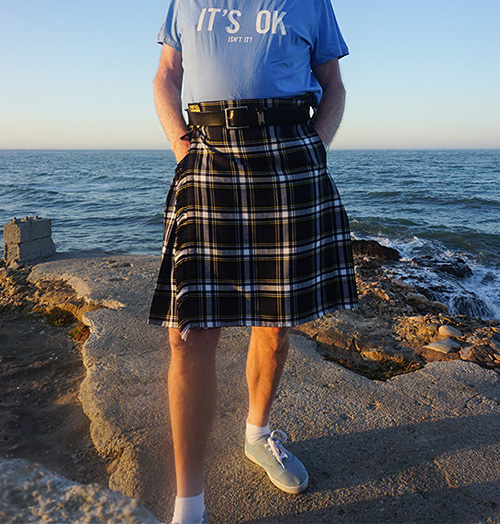
Wearing just the kilt is something very non-Scottish. But assuming, you are not Scottish and not in a Scottish context, it is OK - to my opinion.
Smart-casual
There are only four accessories which I consider being really basic. They are1) a sporran
2) a kilt belt
3) kilt socks
4) garters
To some they might be one or two too many; to others too few. But let's go through them.
A sporran
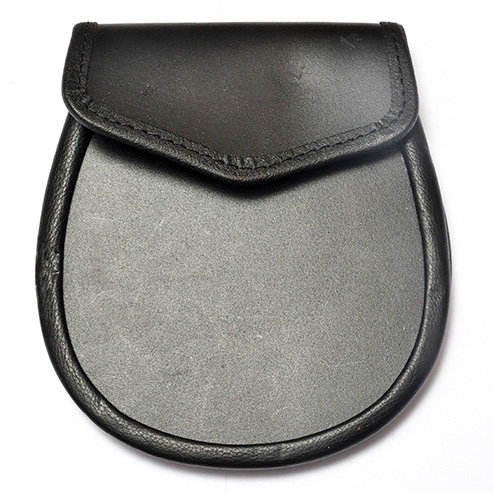
A traditional kilt has no pockets. The “authorized” pocket for a traditional kilt is a purse to hang on your front. It is called a sporran.
There are three types of sporrans, dress sporrans, semi-dress sporrans, and day wear sporrans. For casual wear the day wear sporran is the right one. Sometimes it is called a leather day sporran.
With or without tassels?
Most sporrans on the market come with tassels on the front. When you are walking they make you sound like a drummer. To most kilt wearers it seems to be OK. To me it is not.I suggest you go for a plain leather day sporran without these noisy and annoying tassels.
Earlier mentioned Championkilts.com is selling some sporrans without tassels.
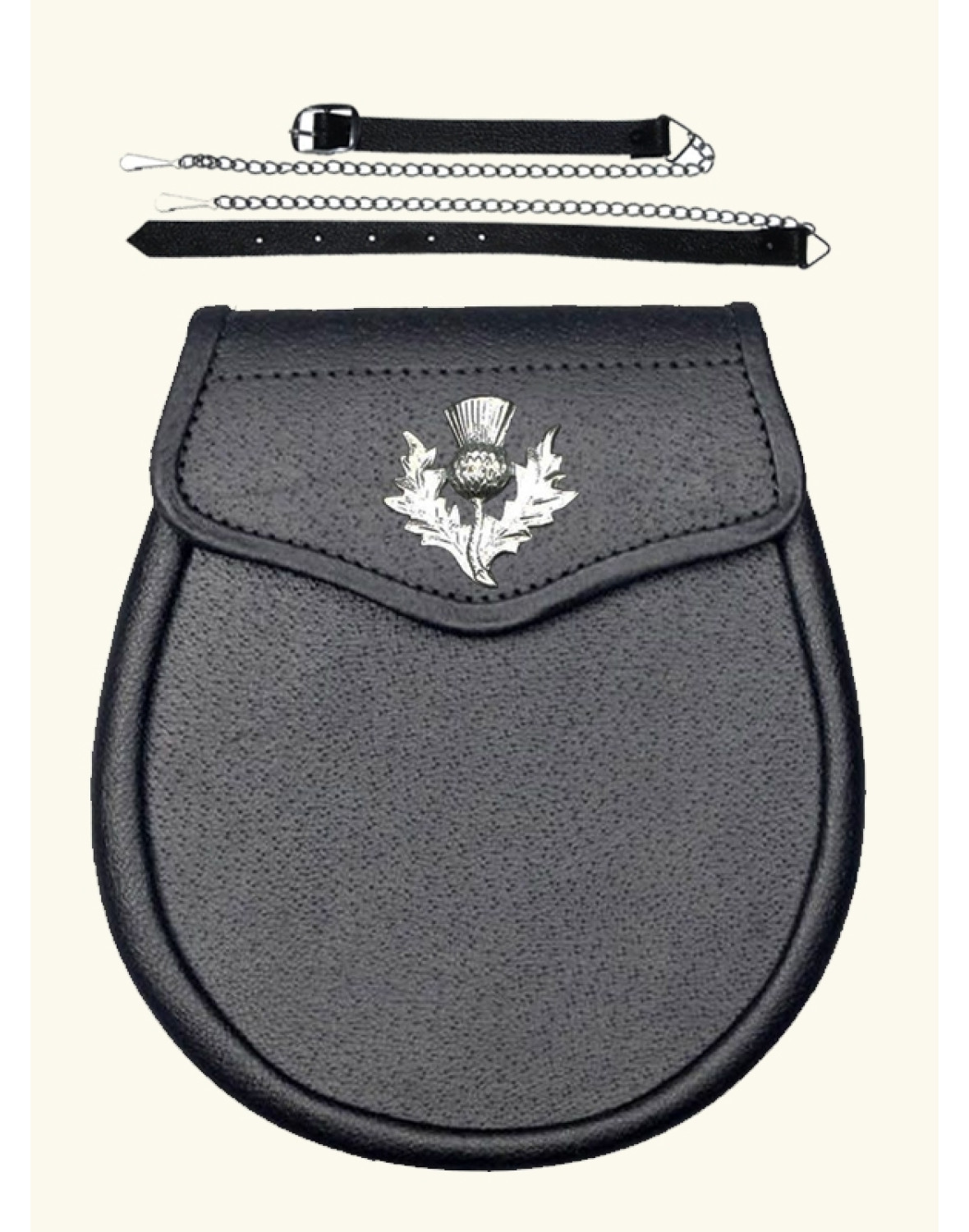
The picture is property of Championkilts.com, published here with their permission.
Often sporrans with tassels are cheaper than those without them. An example is this fine and most affordable sporran from Tartanista London.
If you buy a sporran with tassels, and you don’t like the noise they produce, cut them off. Just be sure that they are fastened under the sporran flap. On most sporrans they are.
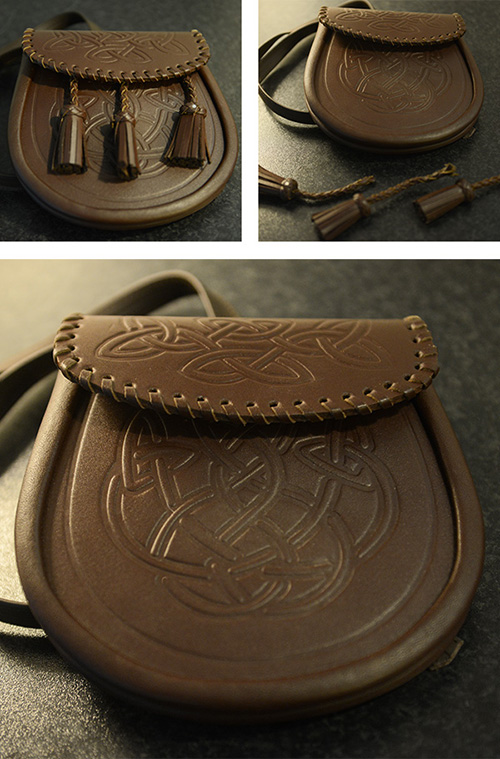
The three holes for the tassels are covered by the flap.
Chain or strap?
With very few exceptions, sporrans are delivered together with a metal sporran chain.A chain can be a little bit hard on your kilt, however. That is what many frequent kilt wearers think, and accordingly they, for casual wear, prefer a leather strap. Me too.
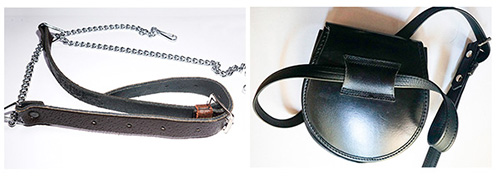
I have made me some black and brown leather straps for my day sporrans. But such ones are also to buy.
From Tartanista they are to have in black and brown at most affordable prices.
Must I wear a sporran?
Going without a sporran is definitely against rules. Kilt and sporran are often considered strongly connected items. Some kilt wearers will even say that without a sporran a kilt is a skirt. That makes no sense. A car from which something as essential as the wheels have been stolen is still a car, is no bycycle or whatever. But back to the question, you must not.About the casual kilt CLAN says

This opens up the casual kilt to a wider range of styling options. It's ultimately more of a fashion garment, so it's fine to style your casual kilt your own way. There's no real expectation that you'll wear it with the usual accessories like sporrans and kilt pins that conventionally go with a traditional kilt. But you can of course if you like. A casual kilt is more like trousers to the extent that anything goes.
In disfavour of the sporran is also the fact that today’s smart phones have become big, very big, and soon they’ll grow out of sporrans, meaning you must have another place to accommodate them. Or sporran makers are to adjust sizes in accordance with today’s needs.
If your kilt is designed to sit low, which, according to CLAN, a casual kilt should, a sporran might either hang too low or be too close to the top of the kilt.
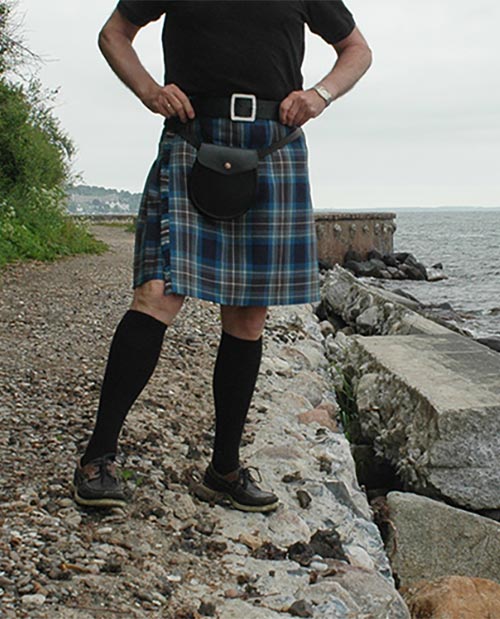
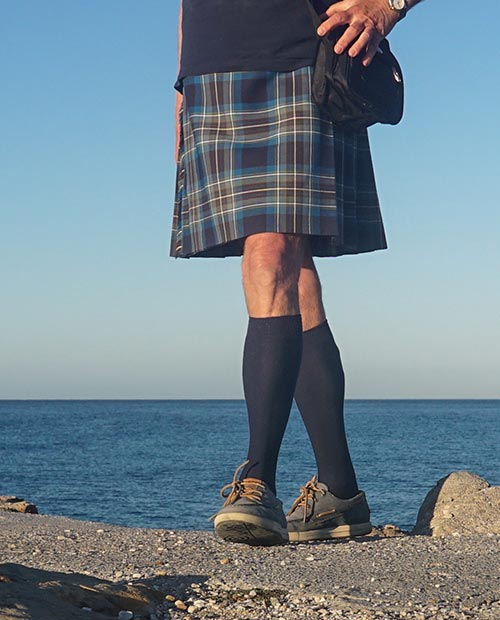
However, my wife, thinking that a kilt, to her opinion, looks much better without it, made me start leaving the sporran at home.
At first, I thought it was wrong, but now it has become a natural thing to go without it and no one cares. Ditching it certainly also adds to comfort.
In my case it has devoloped into the folowing practice:
Casual wear, never sporran
Smart casual wear, about 75% without/25% with sporran
For more formal wear, always sporran.
But even if I will seldom wear a sporran anymore, I still consider it a "must have" thing. And especially if you should be living closer to a Scottish environment than do I.
My advice, don't spend too much money on it.
A belt
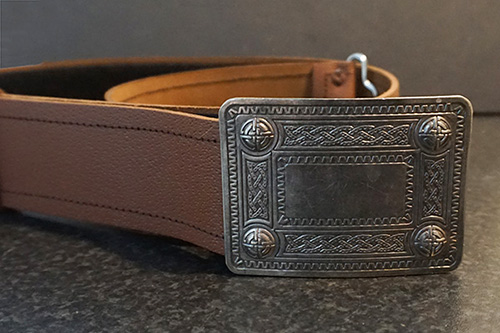
An original kilt belt & buckle might be a little bit overdressed for casual wear; nevertheless it looks quite good; and wide-enough ordinary belts are hard to find elsewhere. Also, kilt belts and buckles are most affordable, so go for them. You might have a look at Tartanista, London
There are some less 'Scottish' alternatives, however. Before mentioned Championkilts.com is, along with ordinary kilt belts, selling some doppel prong fashion kilt belts.
A so does Tartanista.
I have made my own belt but it hardly pays out when you can get one that cheap.
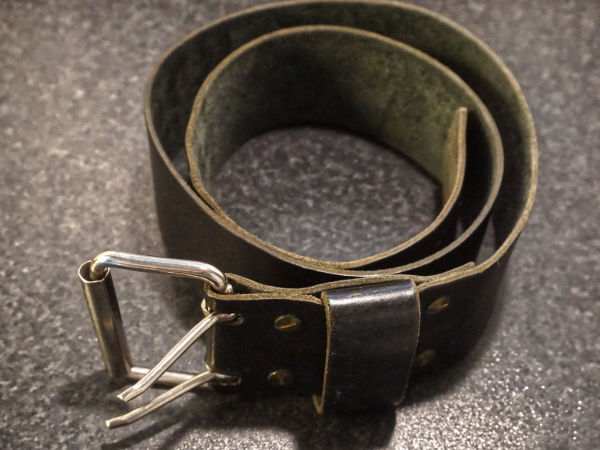
Must I wear a belt?
Technically there is no reason why you should wear a belt with a kilt. By means of buckles and straps it stays up perfectly well. However, a kilt looks at its best together with a 2 ¼-2 ½ inch wide belt.If you are wearing a sweater untucked - as it should be – a belt is unnecessary. If you are wearing a waist coat, you should not wear a kilt belt!
Kilt hose
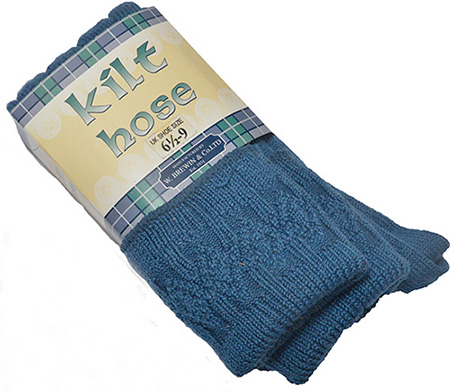
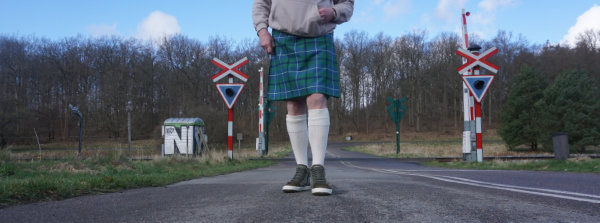
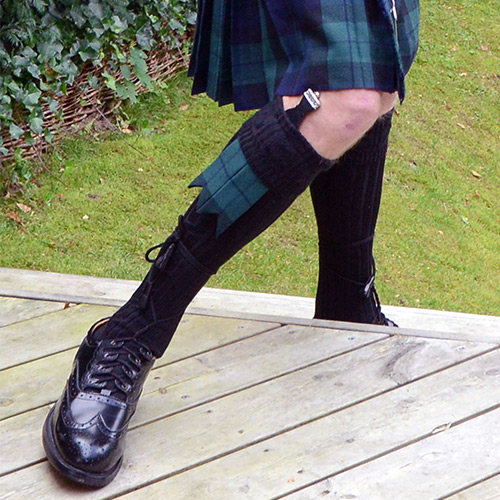
Long socks, called kilt hose or kilt socks are common with the kilt. They are basically "over knees" and meant to be folded down about one inch (2.5 cm) below your knees, contrary to knee high socks that end just below them.
They come in many colours.
White socks, whether long or short, are not to everybody’s taste; nevertheless, most kilt socks are probably white or off white. The reason might be that they'll go with practically every kilt.
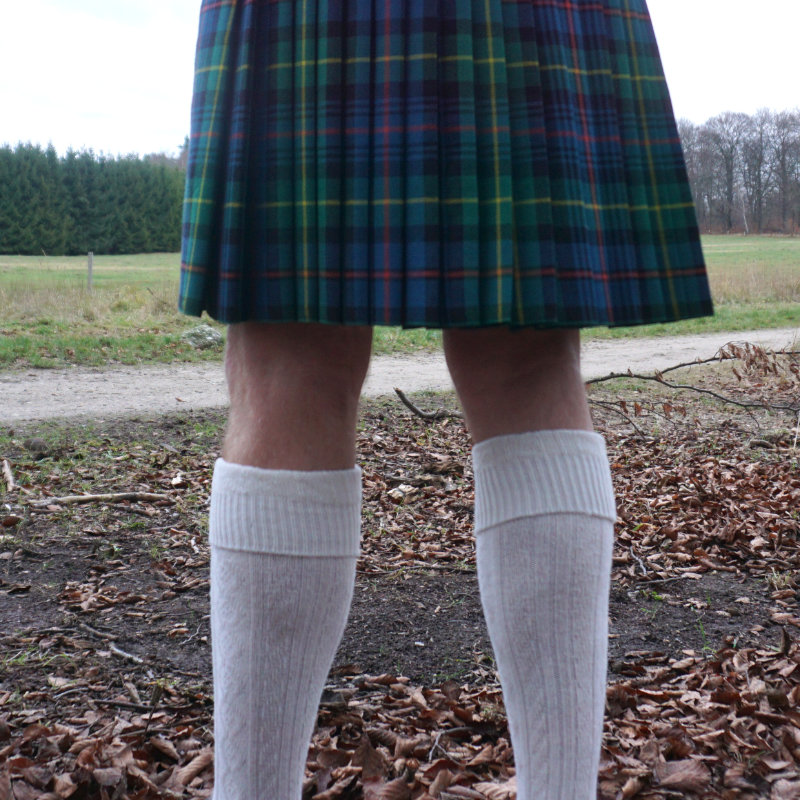
Other popular colours are black, charcoal, lovat green, lovat blue, bottle green, dark grey, bordeaux, red, and navy.
Kilt hose must not be solid coloured. In fact, some Scots like diced ones. So I have been told. I definitely prefer solid coloured socks. In my book, mixing different patterns is bad taste but you do also sometimes see it in women’s fashion. So, we are all different.
All kilt vendors, I know of, are selling kilt hose. You might also take a look at Tartanista.
Due to the customs clearance fee, which always applies when goods are sent from 3rd countries to EU-countries, it might be a good idea to order more socks at a time.
Tartanista claims that when they ship to some EU-countries, like Germany and France, they'll cover the taxes.
Another fine source might be Brevin & Co. Their kilt socks are very good. As they sell via Amazon, you might avoid taxes.
Suggestion - Overknees instead of kilt hose
If your shoe size is 39-43 (6.5-10 US; 6-9.5 UK) you might be able to find some thick overknee socks - in local women's stores or on the internet. In off white or charcoal they have no gender, but might very well be faster and easier to get. In general, prices are attractive, and no taxes and fees come on top.
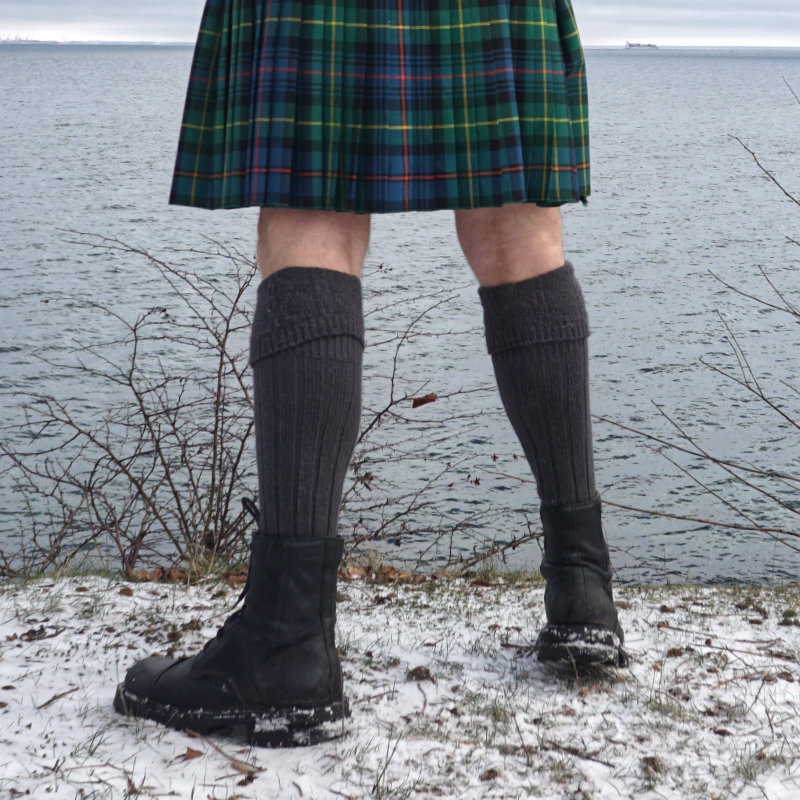
Unfortunately, H&M don't have them on all markets or every year.
5-yard kilt in 13 oz. pure new wool, Farquharson tartan, worn with thick 'kilt socks' from H&M.
Garters
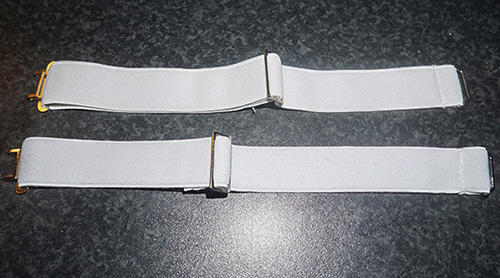
Kilt socks are sliding down, which is most annoying. To overcome this problem, you'll need garters. They are invisible when your socks are folded down just below your knees as they should. I'll go as far as to say that garters are the most important accessory for kilt wearing.
Garters always come with flashes.
Considering, like me, flashes overdressed for casual wear? Just remove the flashes from the garters, or don't mount them. When you think you need the flashes put them on. It is very easy.
This ends the list of the high land items you need when wearing traditional kilts in a smart casual way. For less than £70 you can have them all.
Dress it up a bit
You might invite your wife to a nice restaurant or go to the opera house or theatre. In these cases you'll probably need a few more or other accessories:
A kilt jacket
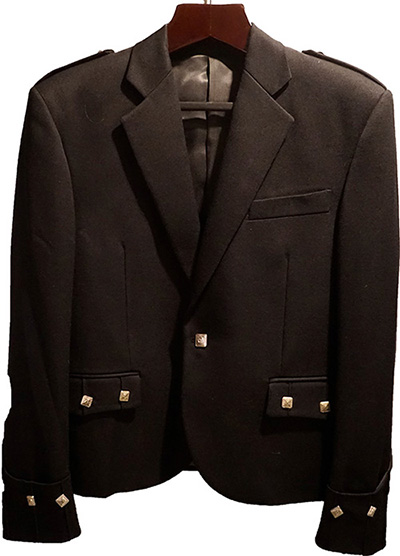
Men's ordinary jackets are too long to wear with a kilt and should look absolutely ridiculous. You’ll have to invest in an Argyle/(Argyll) or Braemer, of which the Argyle is the most popular one. It is available in various colours like lovat blue, lovat green, and of course black, the latter probably being the most versatile one. Price level £150-£250.
Flashes
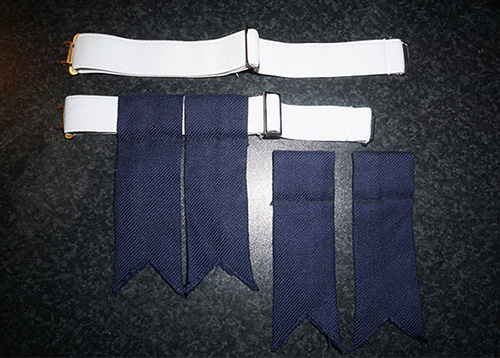
Supposing you already have garters, you’ll also have flashes. For dressing up they might be fine. How to wear them is described on the next page.
A kilt pin
Many kilt wearers are always wearing a kilt pin. It is cheap, and if you want one, buy one, and wear it. Also, for casual wear.
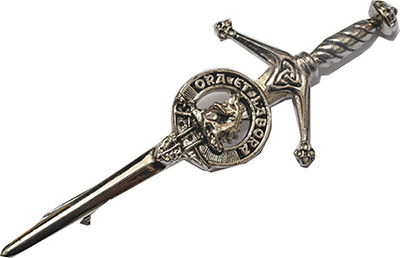
A kilt pin is for pure decoration and to be fastened to the outer apron about three inches up from the bottom of your kilt and about two inches from the apron fringes.
Some will say a kilt pin, due to its weight, helps keeping the kilt down in windy weather. It is not my experience.
For obvious reasons a kilt pin is not welcome on board a flight.
Kilt pins are available in many designs. From about £10.
I have several kilt pins, but I will only wear them at dress-up situations and even then, far from always.
A warning
By NO means a kilt pin shall hold the two aprons together. It should destroy your precious kilt in no time!
Taking it further
For dress up situations where you could not go without your best evening suit, you might need some extras.
A sgian dubh
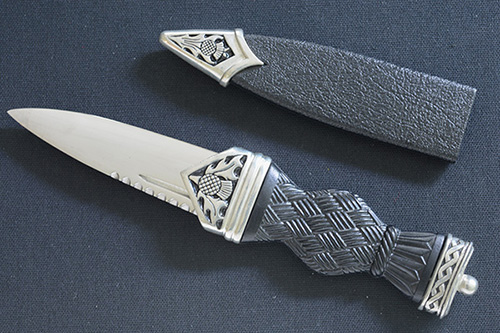
The sgian dubh is the Gaelic name for the special knife to be worn in your right (or left) kilt hose. Be aware, however, that in some countries the wearing of it could bring you to jail if the blade is a little bit too long. And don't even think of wearing one in an airport.
You can have sgian dubhs which are made of harmless plastic, and nobody knows until you draw it. But also replicas of weapons may not be permitted on board an airplane or they might otherwise be considered illegal.
I will only wear a sgian dubh at dress up occasions AND when at no risk of being accused of illegal possession of weapons.
Ghillie Brogues
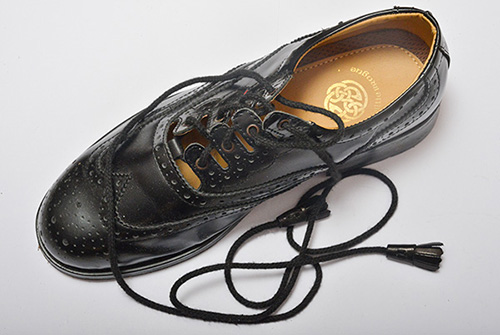
Special shoes with long laces to tie around your ankle. Unless you'll wear your kilt at white or black-tie events, you don't need them.
The full packet
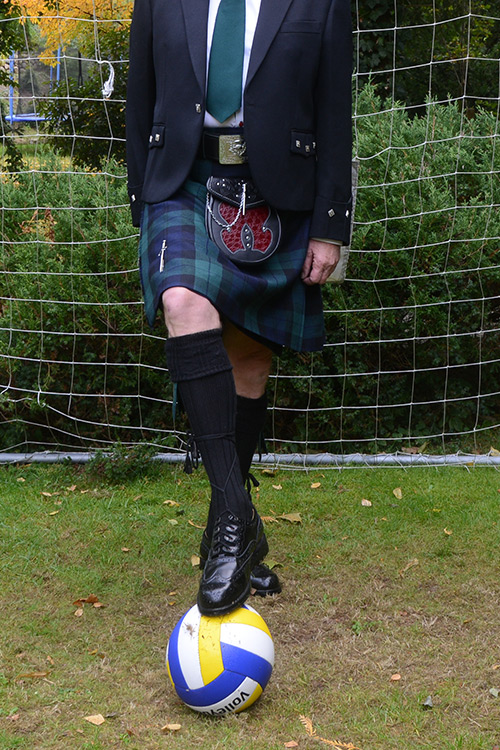
Ready for the concert hall
But less will do. You may refrain from the ghillie brogues. For the concert hall, theatre, and opera house they are a bit over-dressed. Ordinary dress shoes will do. And you can let the sgian dubh at home.The two pictures above illustrate where many other kilt sites start. Should you like to know more about how to dress for such rare occasions you'll find excellent advice on some of tthem.
To my opinion, they are big overshooting the mark when it is about wearing a kilt as daily attire, meaning to replace jeans, shorts and equivalent, and where the kilt should just be considered another piece of clothing, rather than part of national dress.
Don't waste your money
A dirk in the belt, a bonnet, feathers, cap badges, and a plaid over the shoulder? Absolutely NO. Too much national dress and should look rather ridiculous if worn by a non-Scott.Let's sum it up
1. For casual, really casual wear you don’t need accessories at all.
2. For casual/smart casual wear you should probably invest in
a day wear sporran
a kilt belt
kilt socks
garters.
None of the items must be expensive. Black leather things go with all kilts. Black, white, and dark grey or charcoal kilt socks go with most tartans.
3. For dress up events like visiting better restaurants, going to the theatre, concert hall etc. you should complement with a kilt jacket.
All other accessories are up to you, unless we talk black and white tie functions, where rules must be followed.
I prefer, at all times, a nice day wear sporran over a semi-dress one; this due it's cleaner design.
That was what should be said about accessories. Except, perhaps for one thing, which might come in handy; regardless of how you else are going to accessorize your kilt:
Under your kilt?
What you wear – or don’t wear - under your kilt is a matter of personal preferences. But the idea of wearing the kilt “like a true Scotsman” on a more or less regular basis might appeal to many. Probably every kilt wearer has tried it at least once. It is part of the game, isn't it? However, before you ditch your underpants keep in mind: Wool kilts must be dry cleaned and even if some PV-kilts are machine washable they might still need a lot of ironing.With only 5-6 kilt wearers out of 10 (according to earlier mentioned YouGow reserch) wearing regular underwear under their kilt, there should be a big market potential for a solution, at the same time solving the hygiene problem and still letting 'them feel the breeze'.
A kilt liner
Such solution does exist. It is called a kilt liner. But even if making a lot of sense, obviously only one company is selling them, AktiveSkin. Their kilt liner is $24 + shipping (+ VAT, if you are an EU citizen). It is 46 cm long, is made of nylon and comes in two models, one black opaque and one in sheer i.e. transparent nylon.A reason that SktiveSkin is alone on the market might be that some kilt wearers have found other solutions regarding the hygiene issue.
Suggestion - An alternative kilt liner
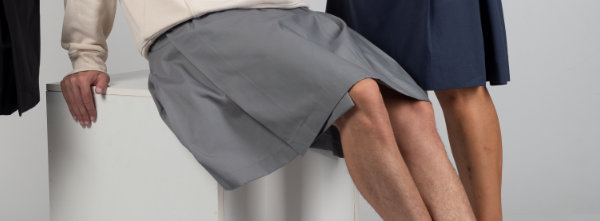
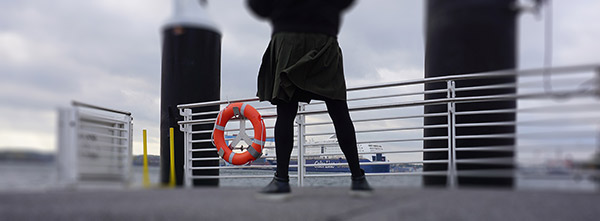
A kilt liner is, in fact, simply a thin skirt or what women might call a half slip. Practically, the same thing you can therefore find easier and cheaper - provided you can accept it to be sold as a skirt – in women’s stores.It is then marketed as a skater skirt, a bell-shaped skirt, or a circular skirt.
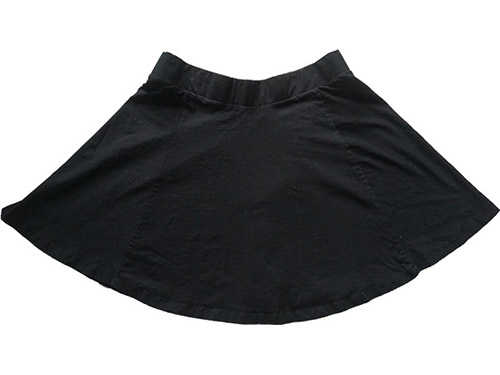
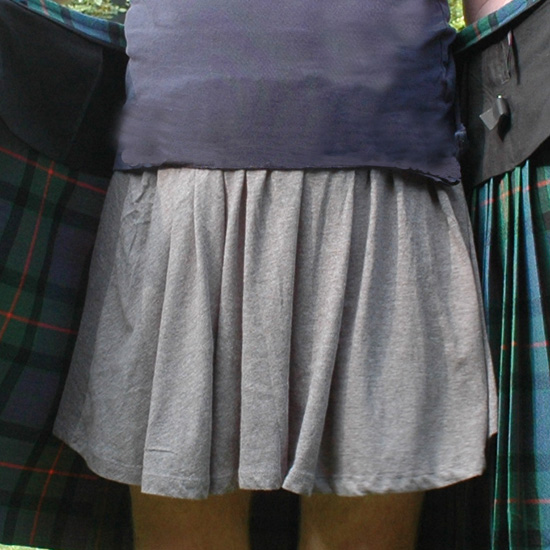
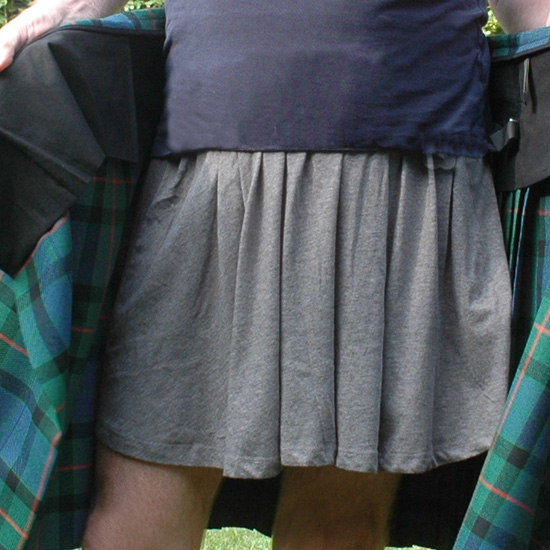
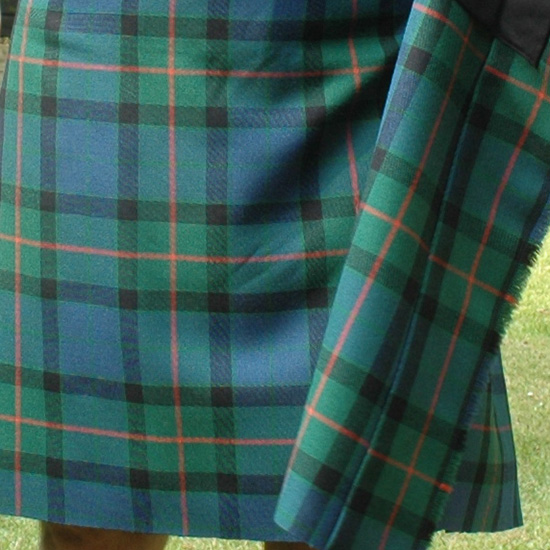
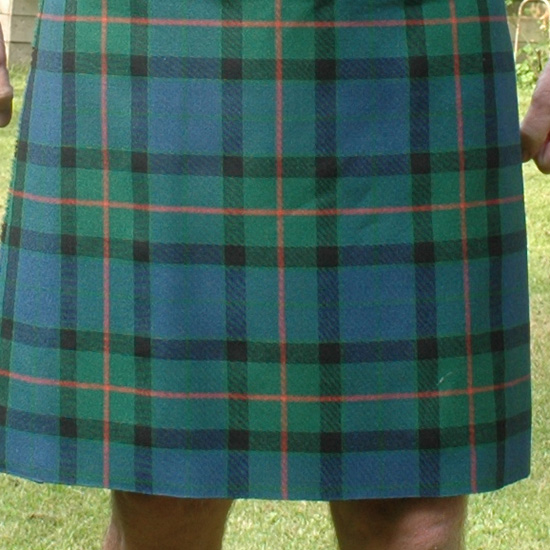
Such skirt is, contrary to the “authorized” kilt liner, wide, really wide, and accordingly much more like a kilt, in fact. The elastic waist and the jersey fabric you’ll know already from your underwear or sport clothes. So, nothing feminine per se about that. When worn under a kilt a skater skirt is just open, roomy underwear, which shall protect your precious kilt efficiently against you.
The skirt shown under the kilt above is grey, but unless the kilt is grey, a black skirt is to prefer, because it better 'disappears' into the shadow under your kilt.
But how about comfort, you may ask, when wearing a kilt liner or skater skirt as underwear? Try it out. I guess you'll find these “semi-commando” things coming very close to the ‘real thing’.
However, if you think tradition must be followed, forget about this advice, whether kilt liner or skater skirt, and do what do you must.
Now, on windy days or when you have to do a lot of sitting there certainly are better, more straight-forward solutions than going full- or semi-commando. And even then, the kilt is a most comfortable garment.
Next page

Kilt on!
You have just received your first kilt and some accessories. Learn how to handle all the unfamiliar things.